Every screen a collections team touches, in one place.
Real screens from the live demo workspace: 60 customers, 18 months of ledger history, Stripe in simulated mode and a sandbox bank feed. Light and dark, phone to desktop.
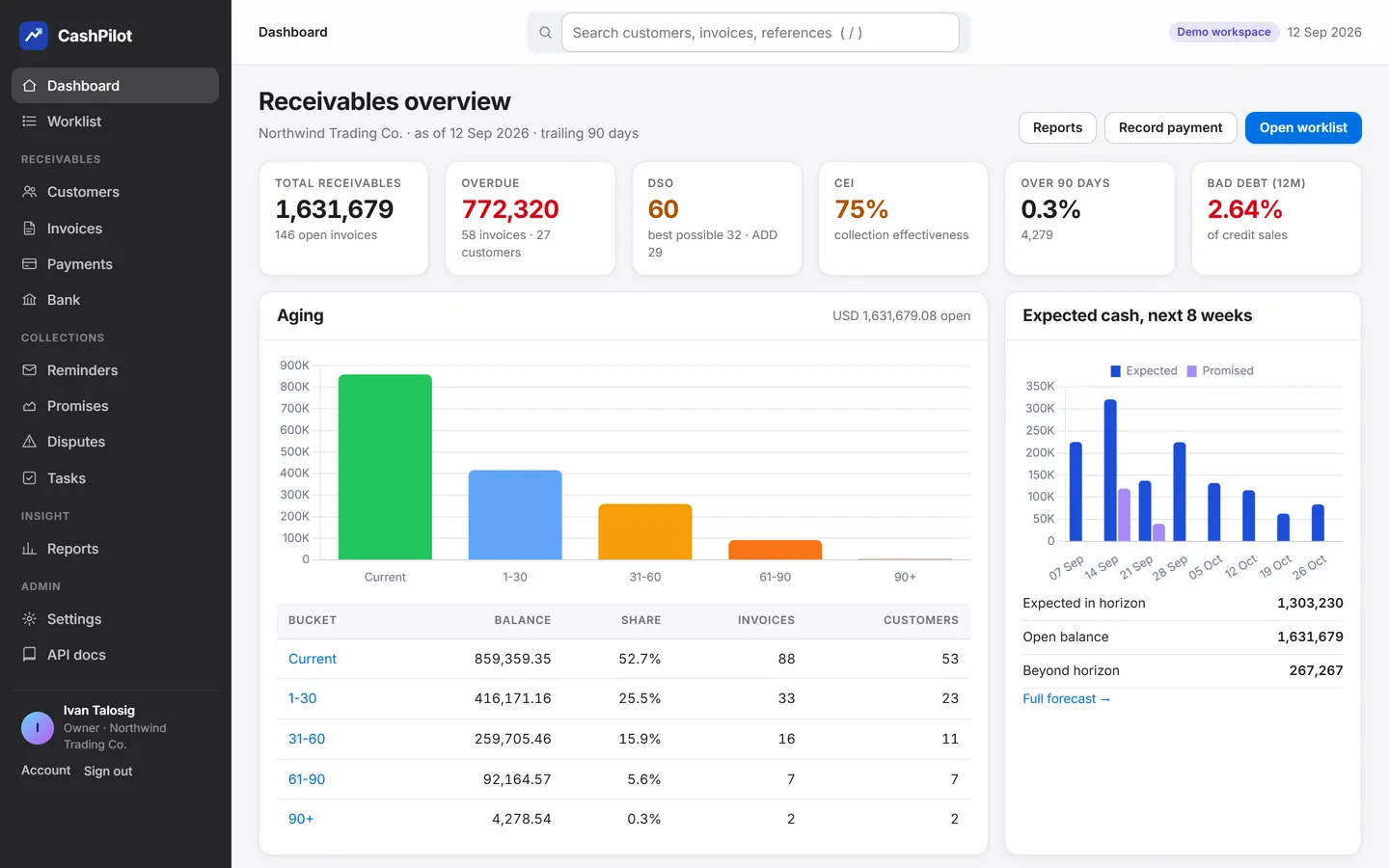
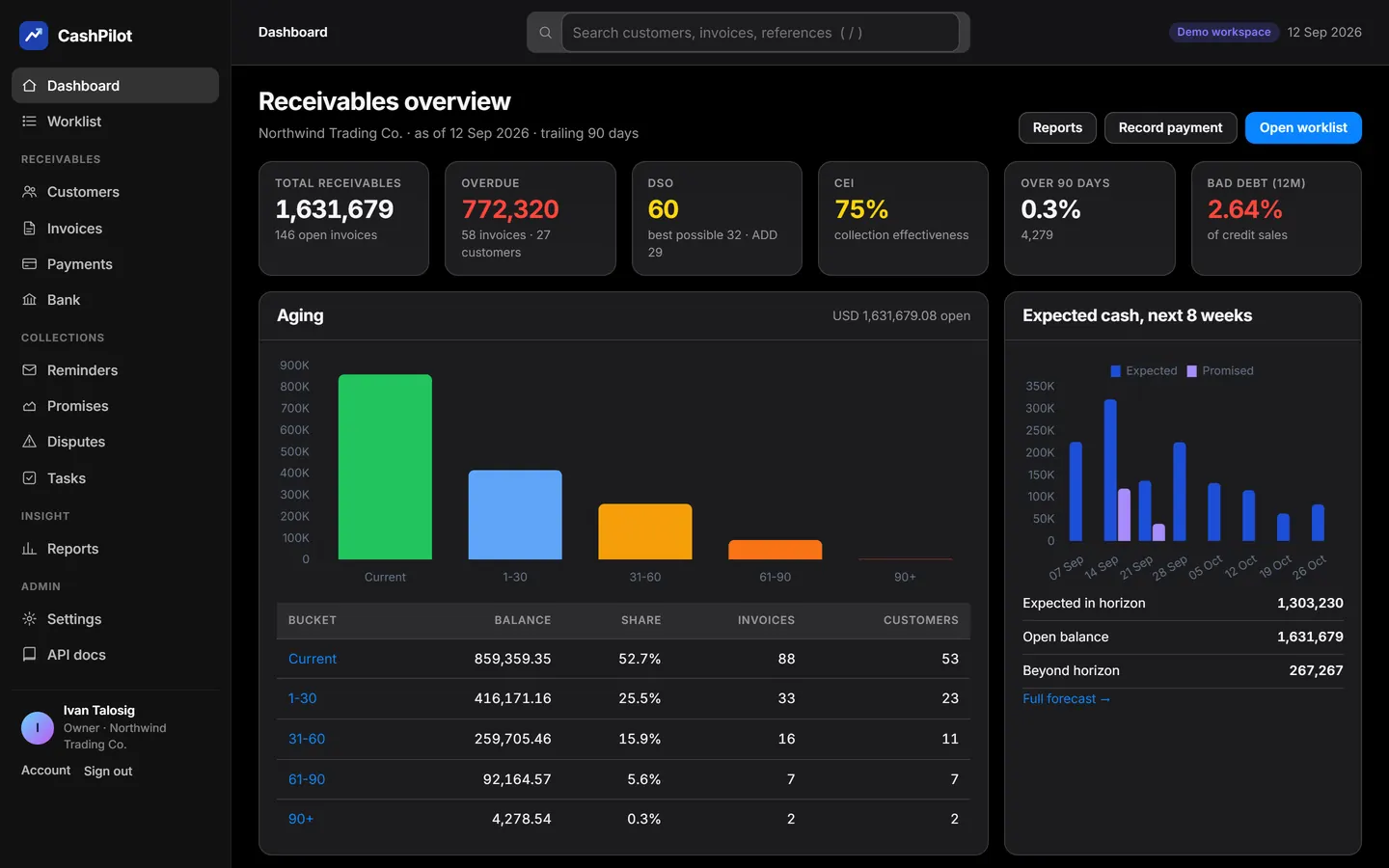
Receivables at a glance.
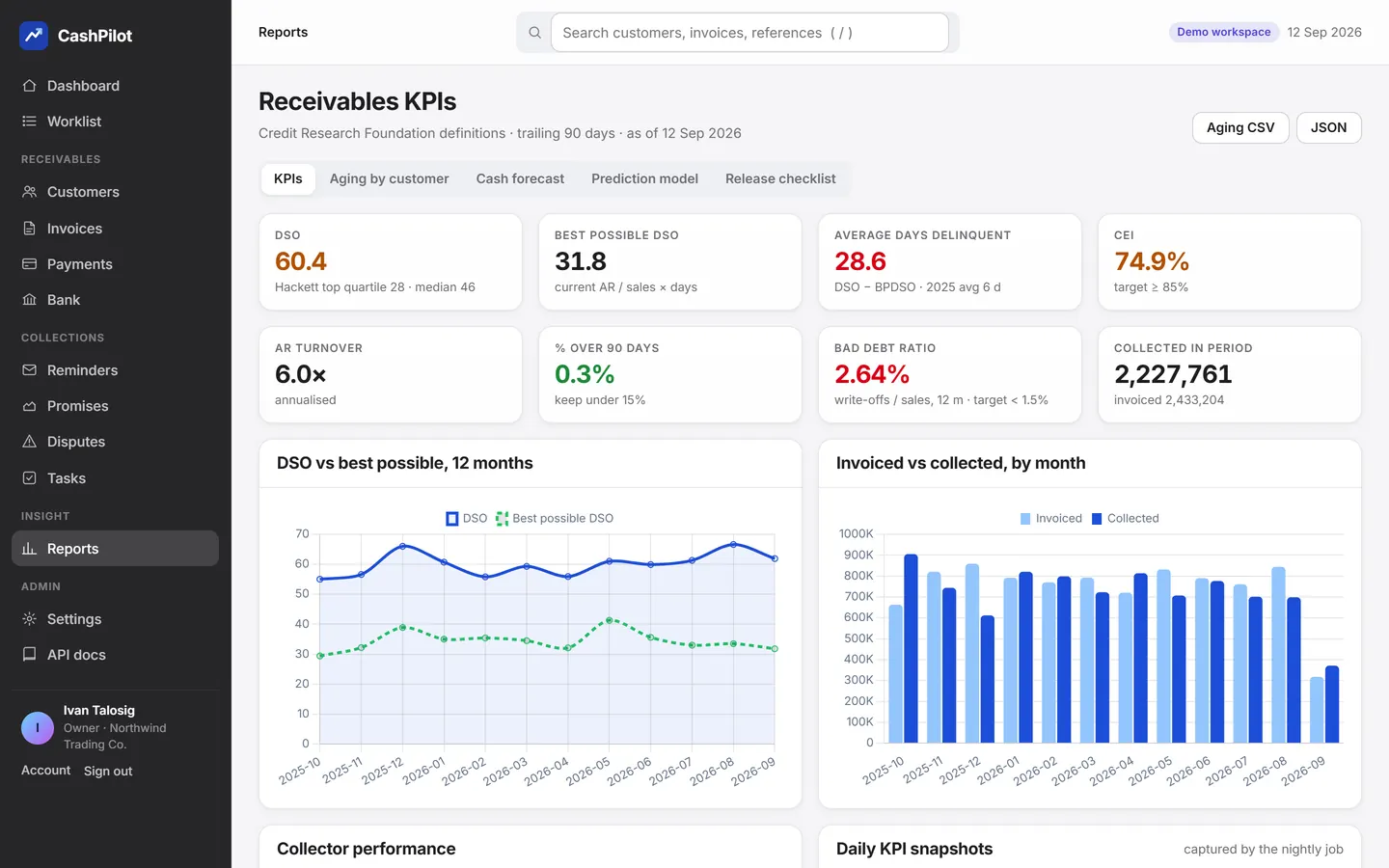
Total receivables, overdue, DSO, CEI, over-90 share and bad debt, with the aging profile and the next eight weeks of expected cash on one screen.
- KPIs to Credit Research Foundation definitions, snapshotted daily.
- Aging by bucket with drill-down to invoices and customers.
- Expected versus promised cash for the next eight weeks.
A model trained on your own invoices.
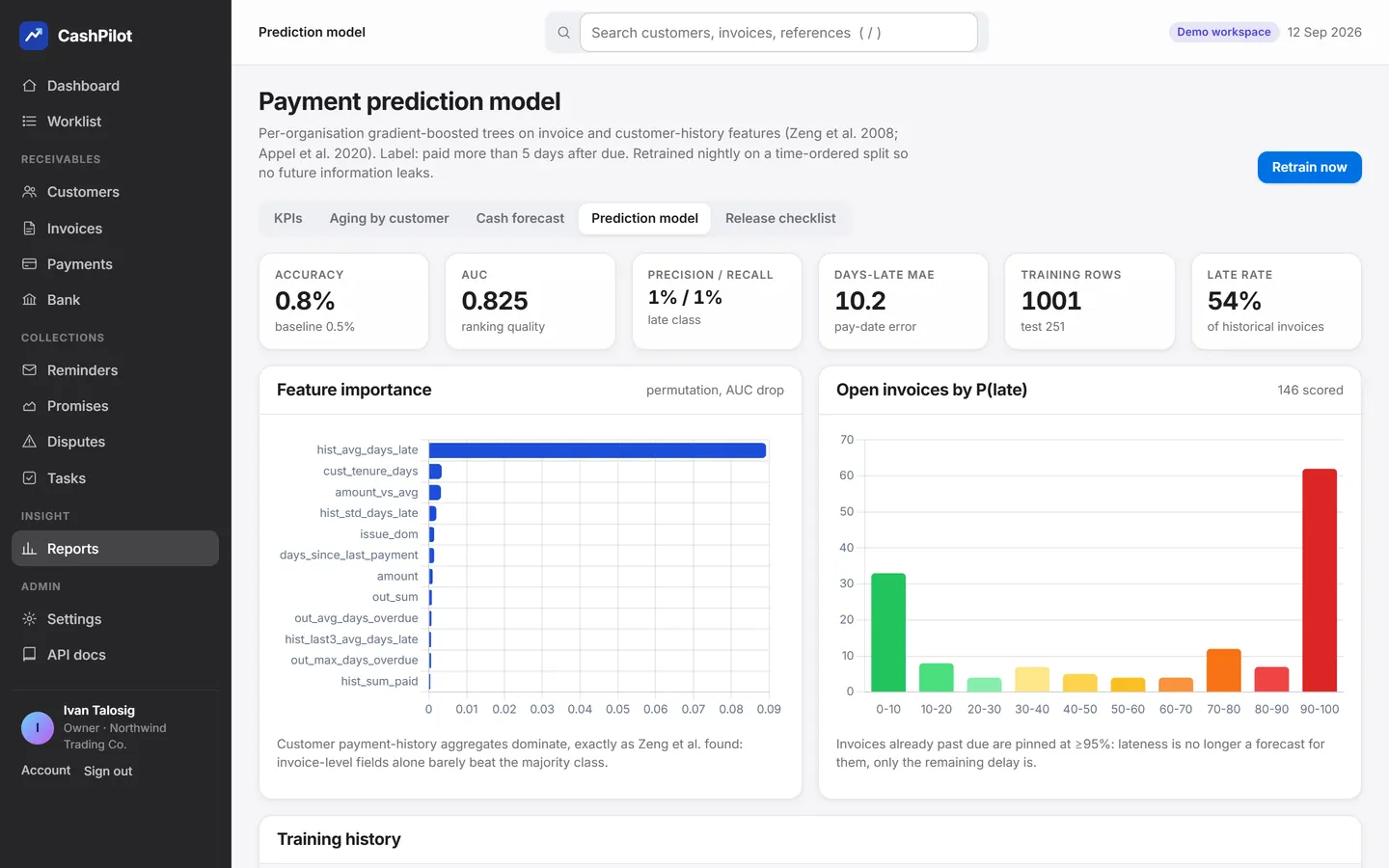
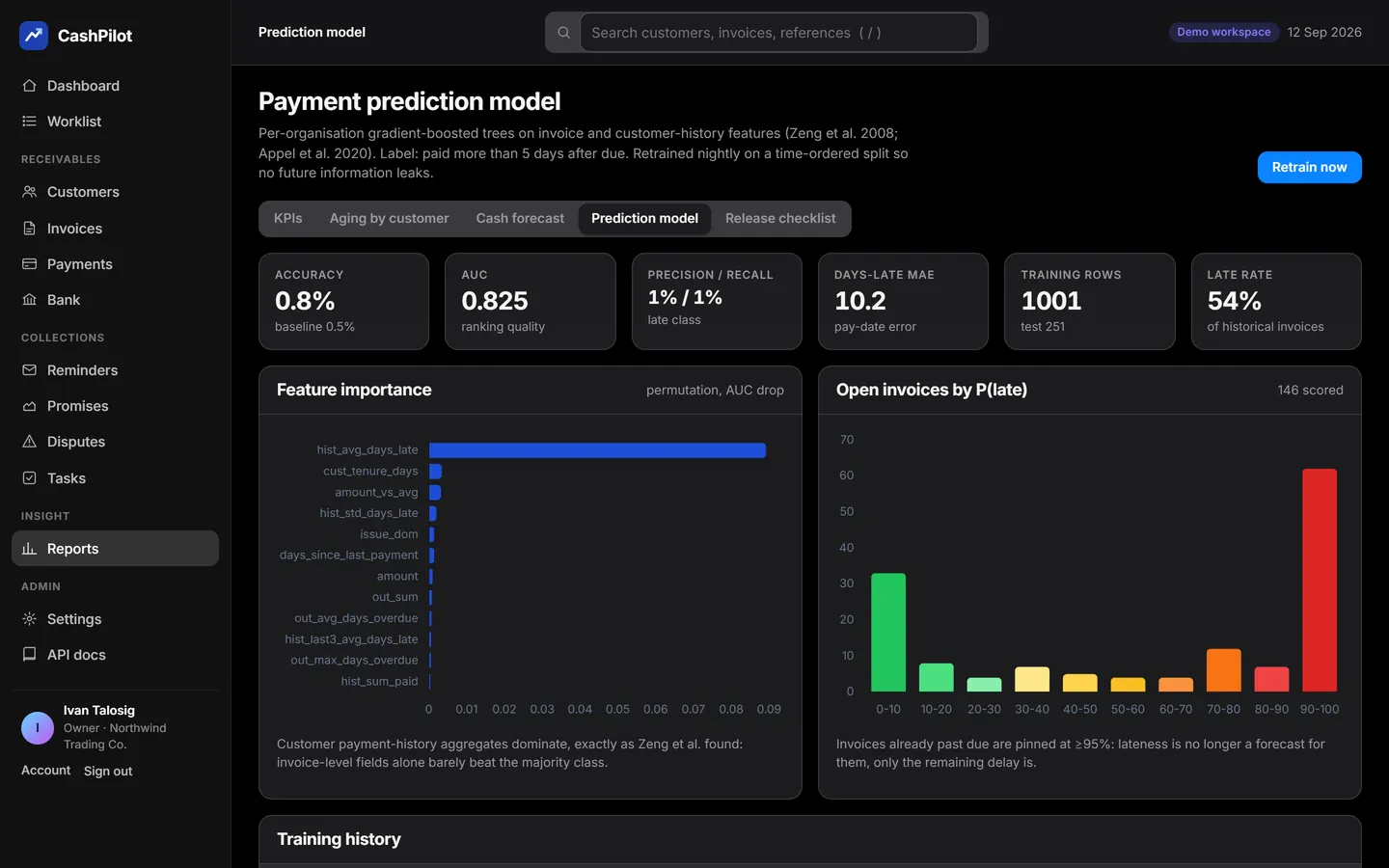
Gradient-boosted trees on 24 features: customer payment history, invoice age and amount, seasonality, disputes and reminder activity. Time-ordered training, so it is only judged on invoices newer than the ones it learned from.
- Probability of late payment and predicted pay date per invoice.
- Calibration histogram, feature importance and backtest on the model page.
- Retrain in one click; scores refresh nightly.
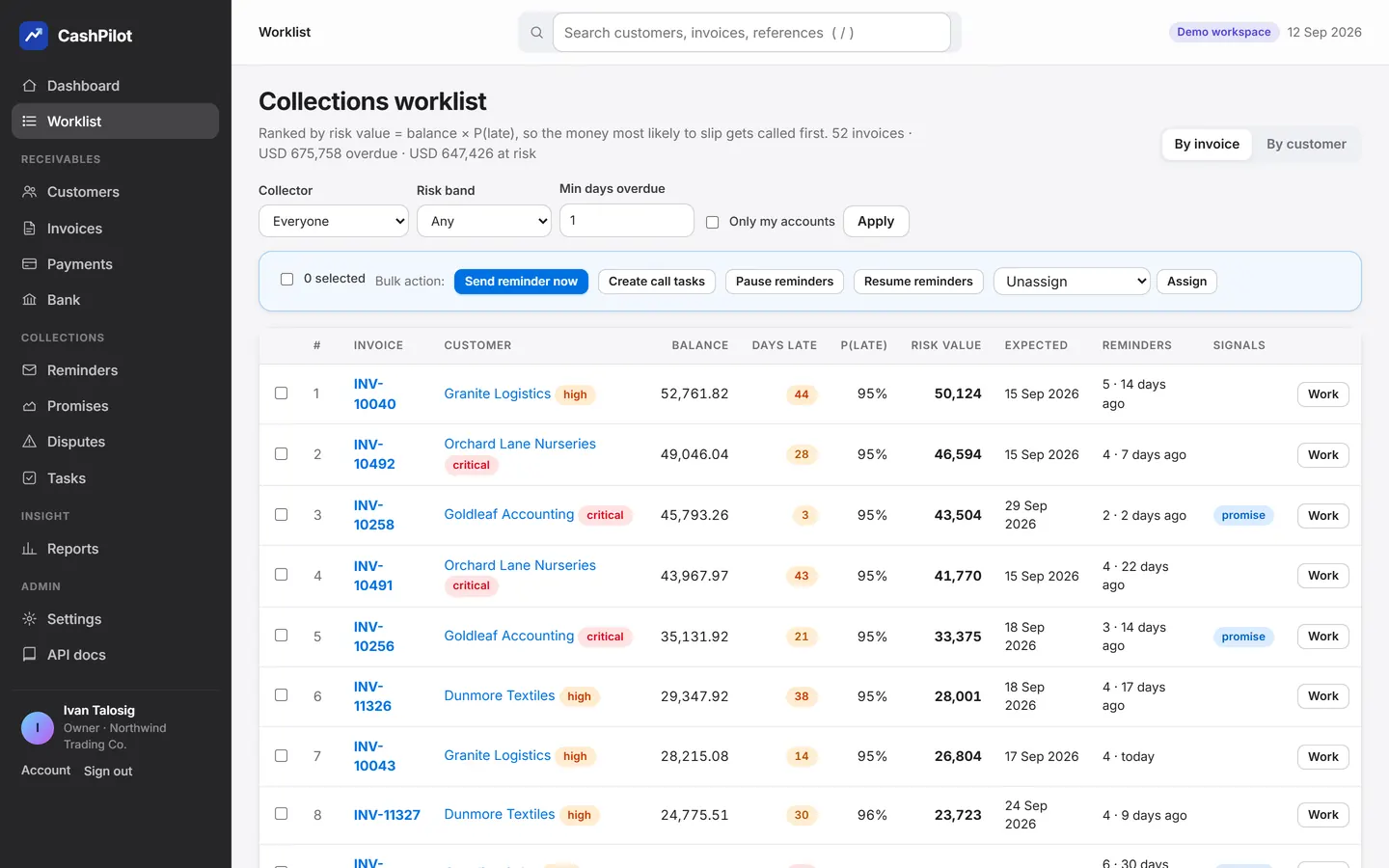
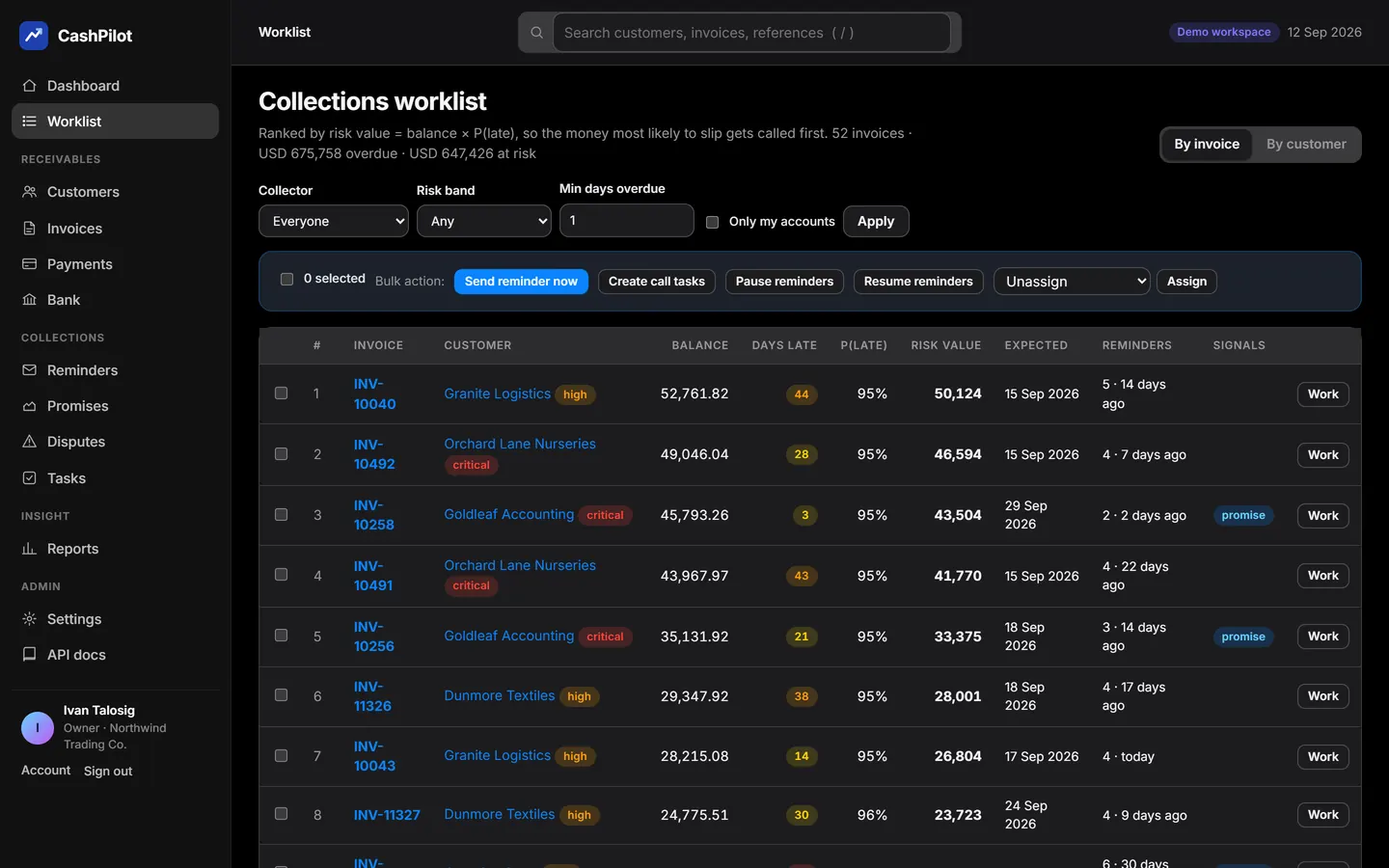
Your collectors' day, ranked by money at risk.
Risk value = balance × P(late). Filter by collector, risk band and days overdue; see promises and disputes on the row; act in bulk.
- Send reminder now, create call tasks, pause or resume sequences, reassign.
- By-invoice and by-customer views, 'only my accounts' toggle.
- Signals column shows promises, disputes and recent contact.
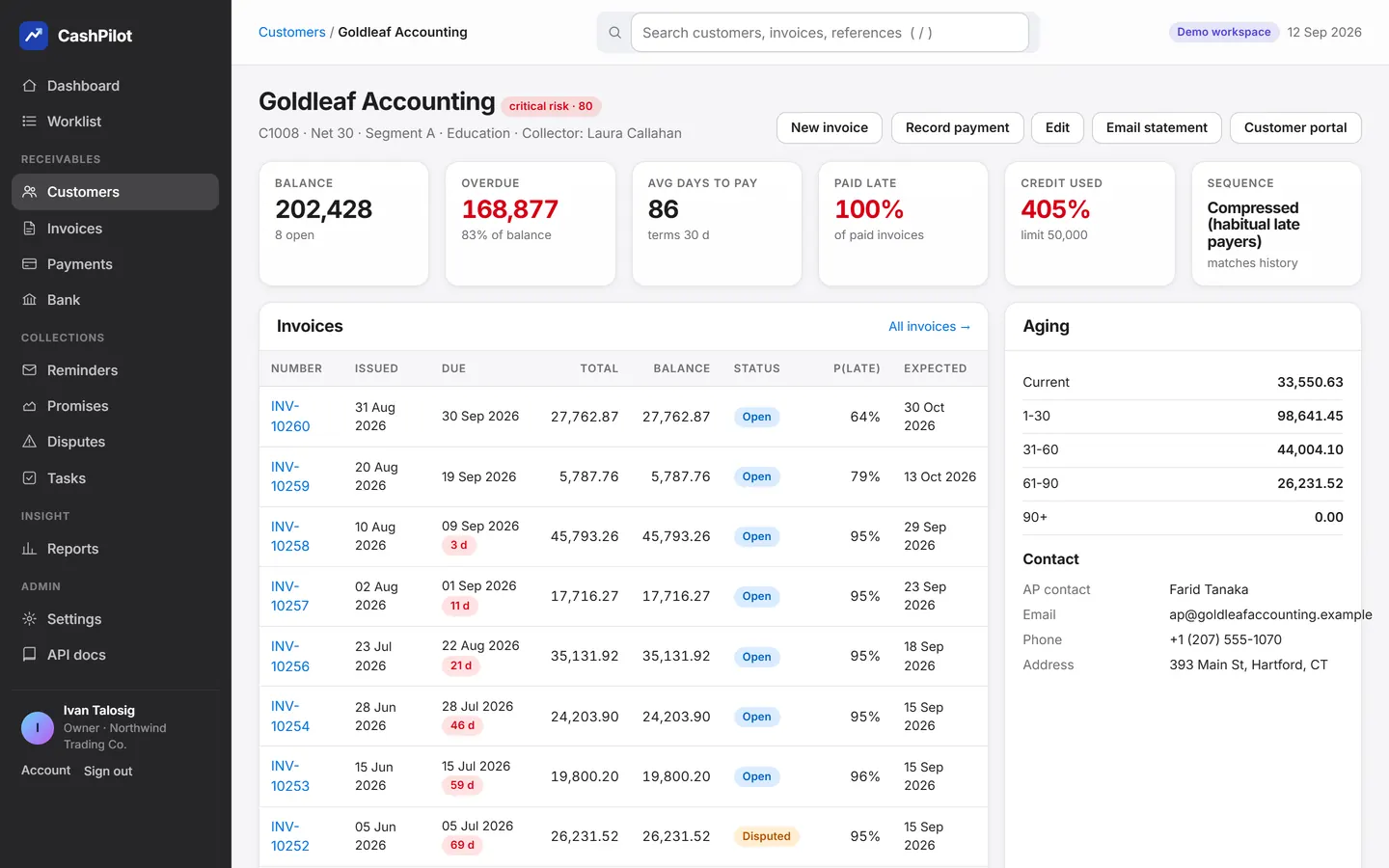
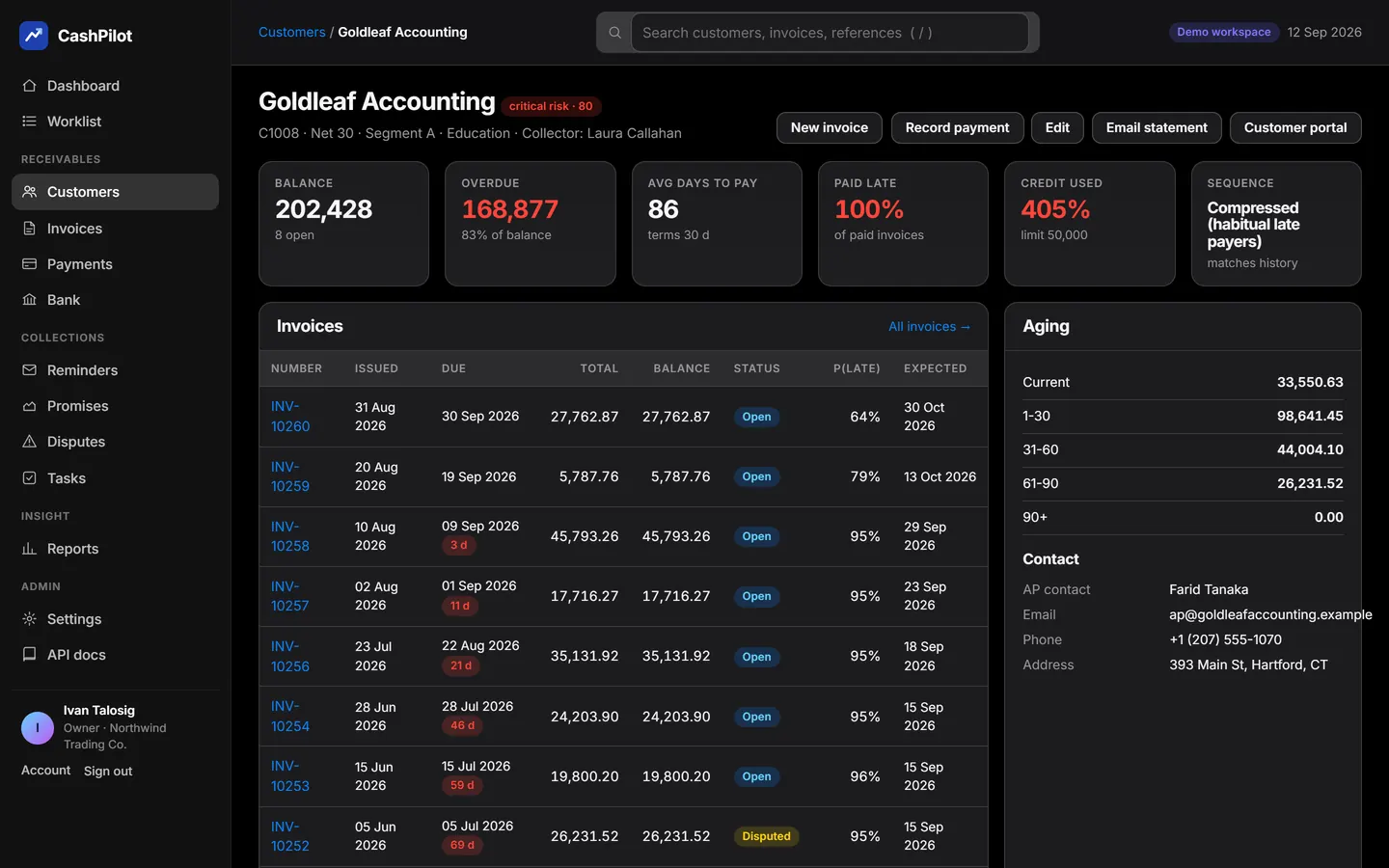
Every customer, with the whole story.
Open balance, risk band, payment behaviour, reminders sent, promises made and kept, disputes and their root causes, plus a one-click statement email.
- Timeline of every reminder, call, promise, dispute and payment.
- Portal link and pay link per customer.
- Root-cause codes on disputes show what to fix upstream.
Sequences that send themselves, with the evidence attached.
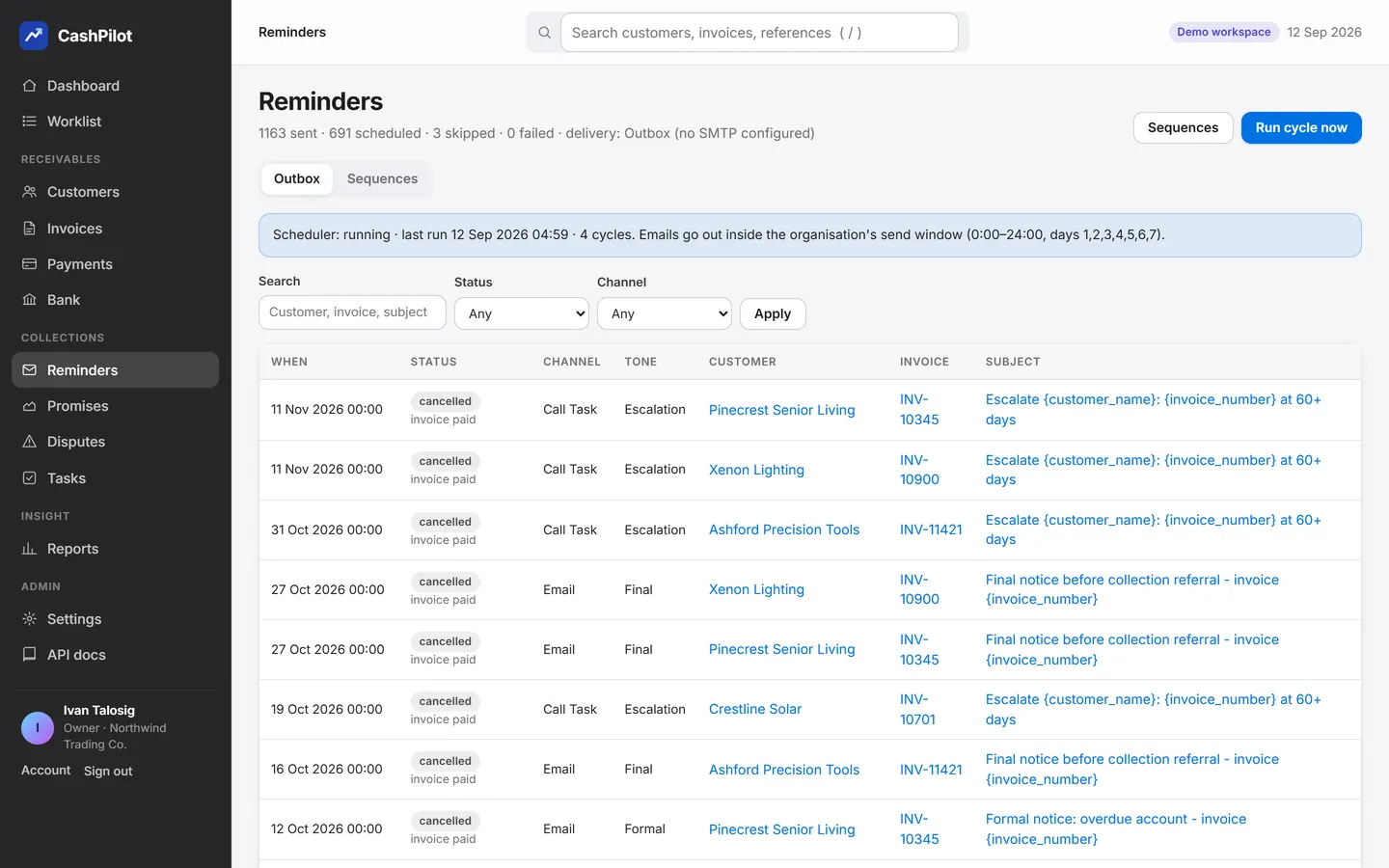
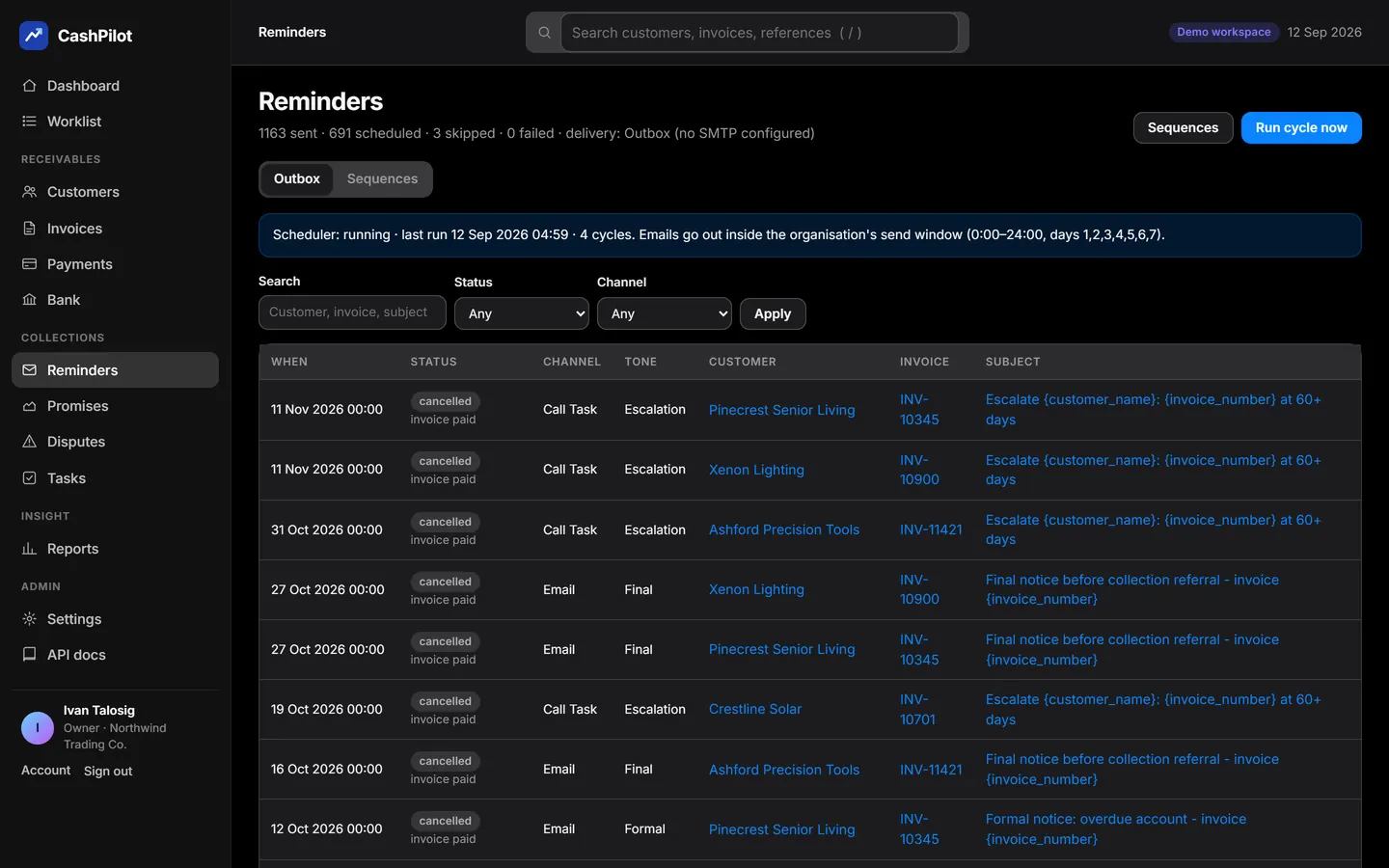
Courtesy at −3 days, then +1, +7, +14, +30, +45 and +60, escalating in tone, inside your send window and time zone. Paused on promise or dispute, resumed when it breaks or resolves.
- Invoice, statement and pay link attached to every touch.
- Segment-specific cadences for reliable and habitually late payers.
- Outbox review if you want it; call tasks where phone beats email.
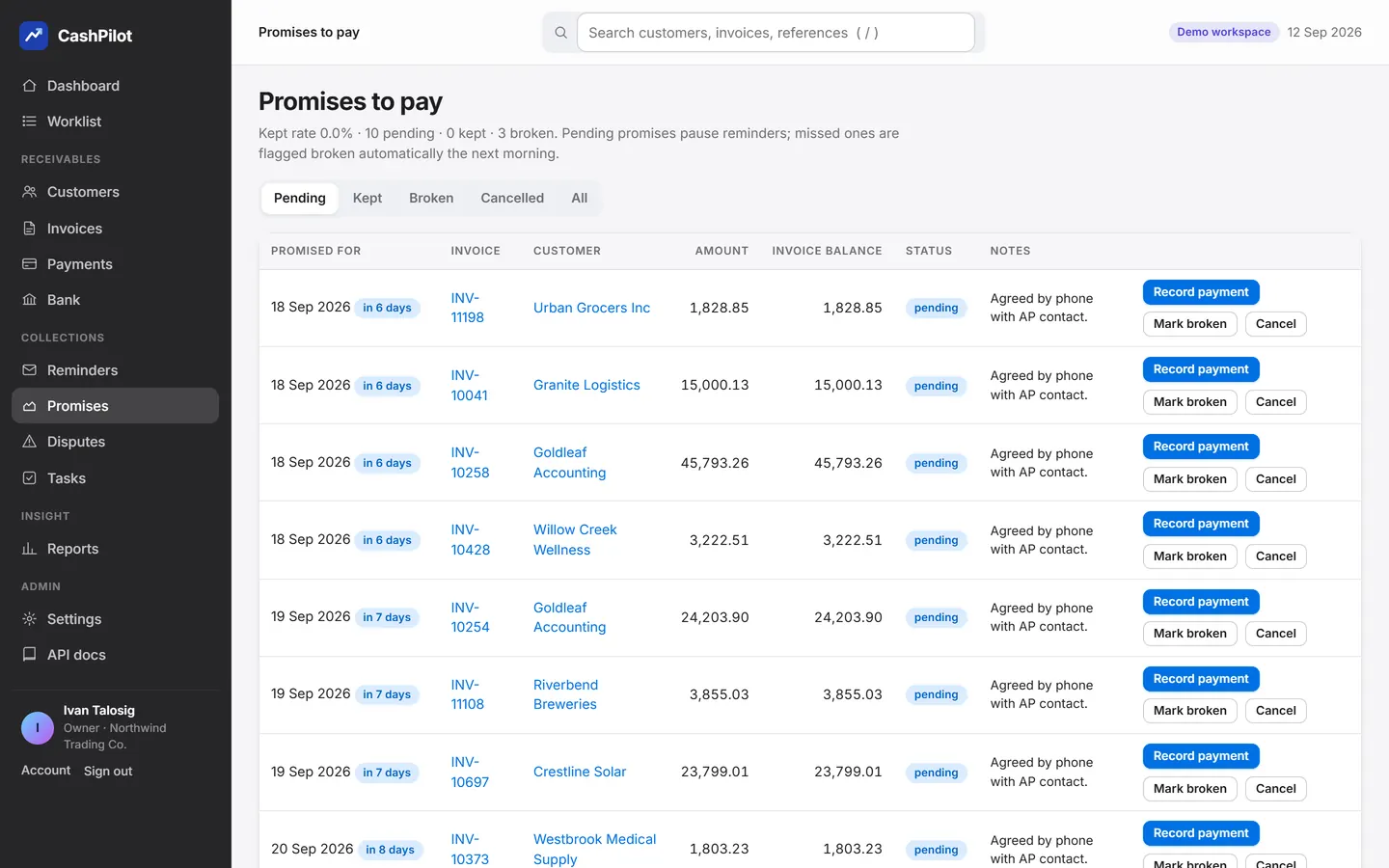
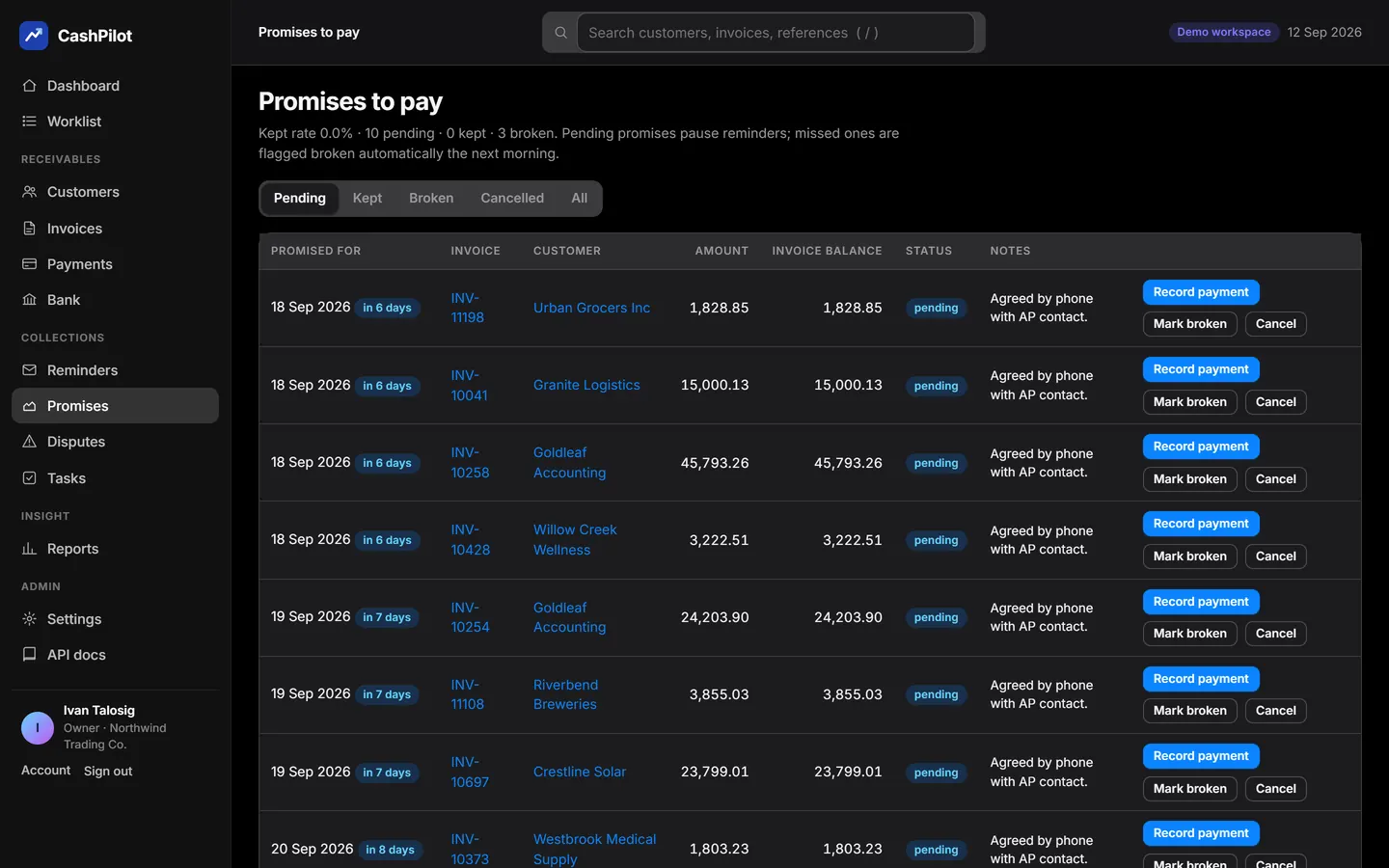
Track what customers said, and what they did.
A promise pauses the sequence and sets a date. If the money does not arrive, the promise breaks and the invoice resurfaces at the top of the next morning's list.
- Kept, broken and pending promises per customer and collector.
- Disputes with root-cause codes and resolution tracking.
- Everything visible on the worklist row.
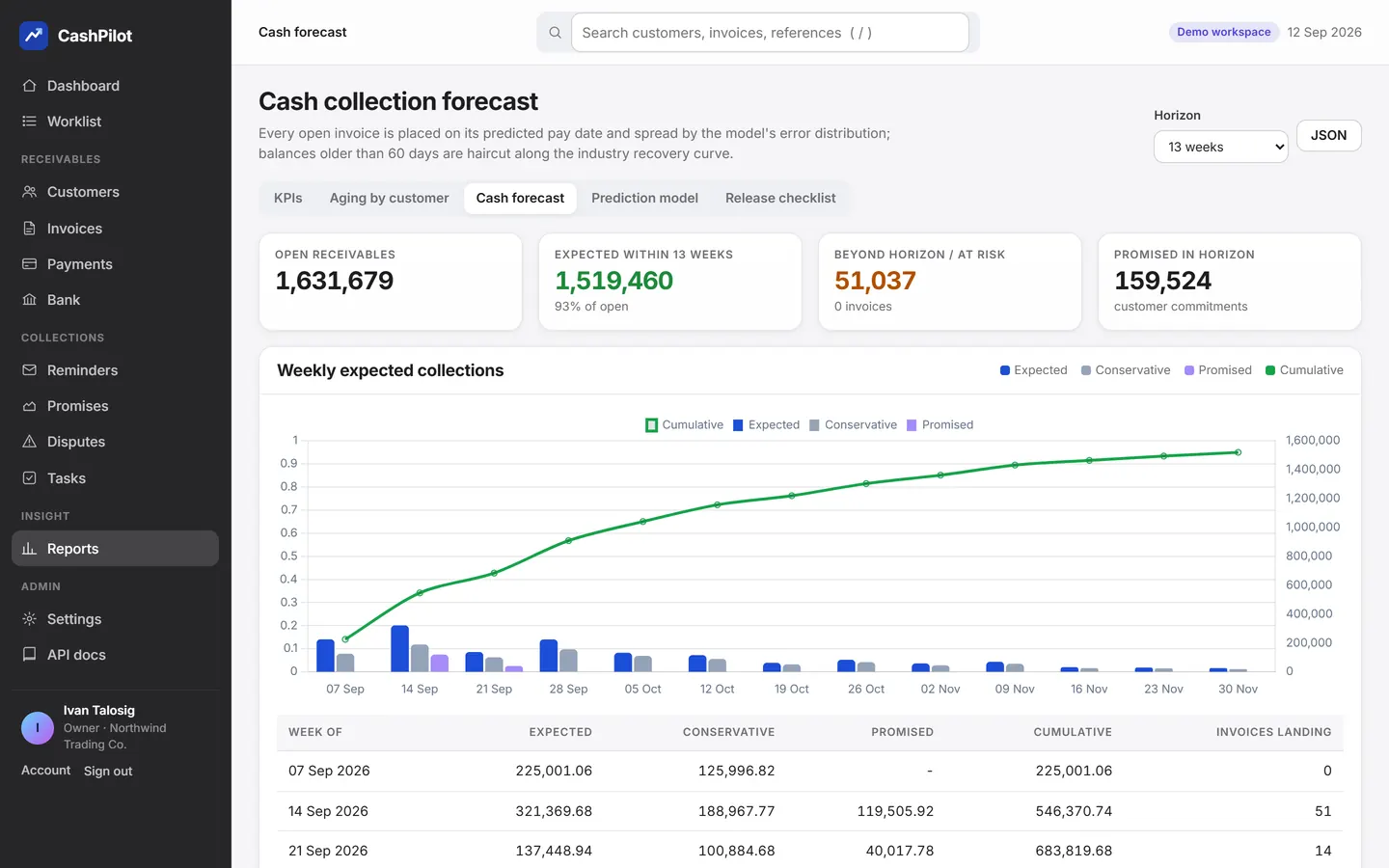
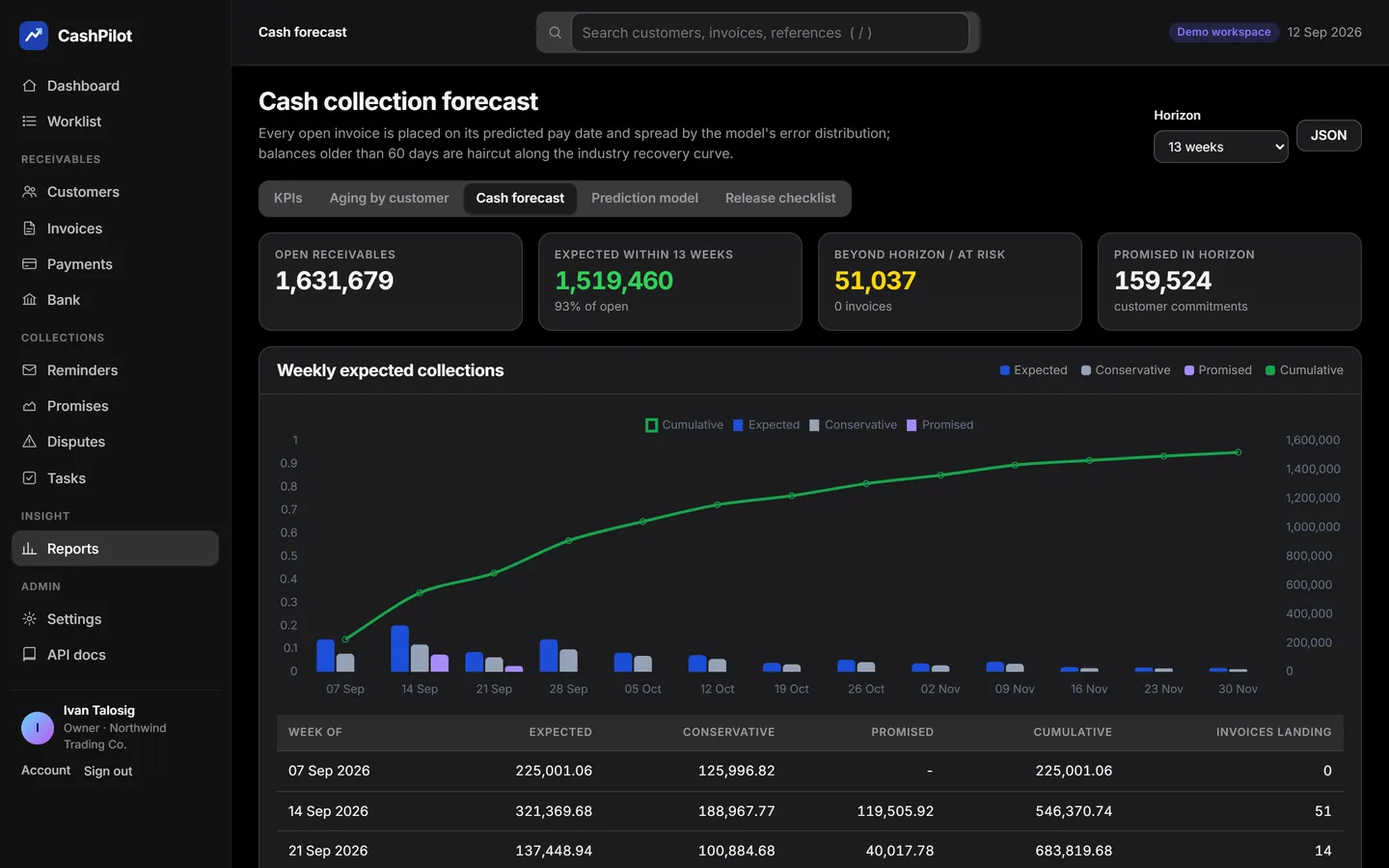
See the next 13 weeks of cash before they happen.
Every open invoice is placed on its predicted pay date and rolled into weekly expected and promised cash, with a conservative haircut past 60 days.
- 4 to 26 week horizon, expected versus promised.
- Invoices expected soonest listed under the chart.
- CSV export and API access.
Cash application without the Friday afternoon.
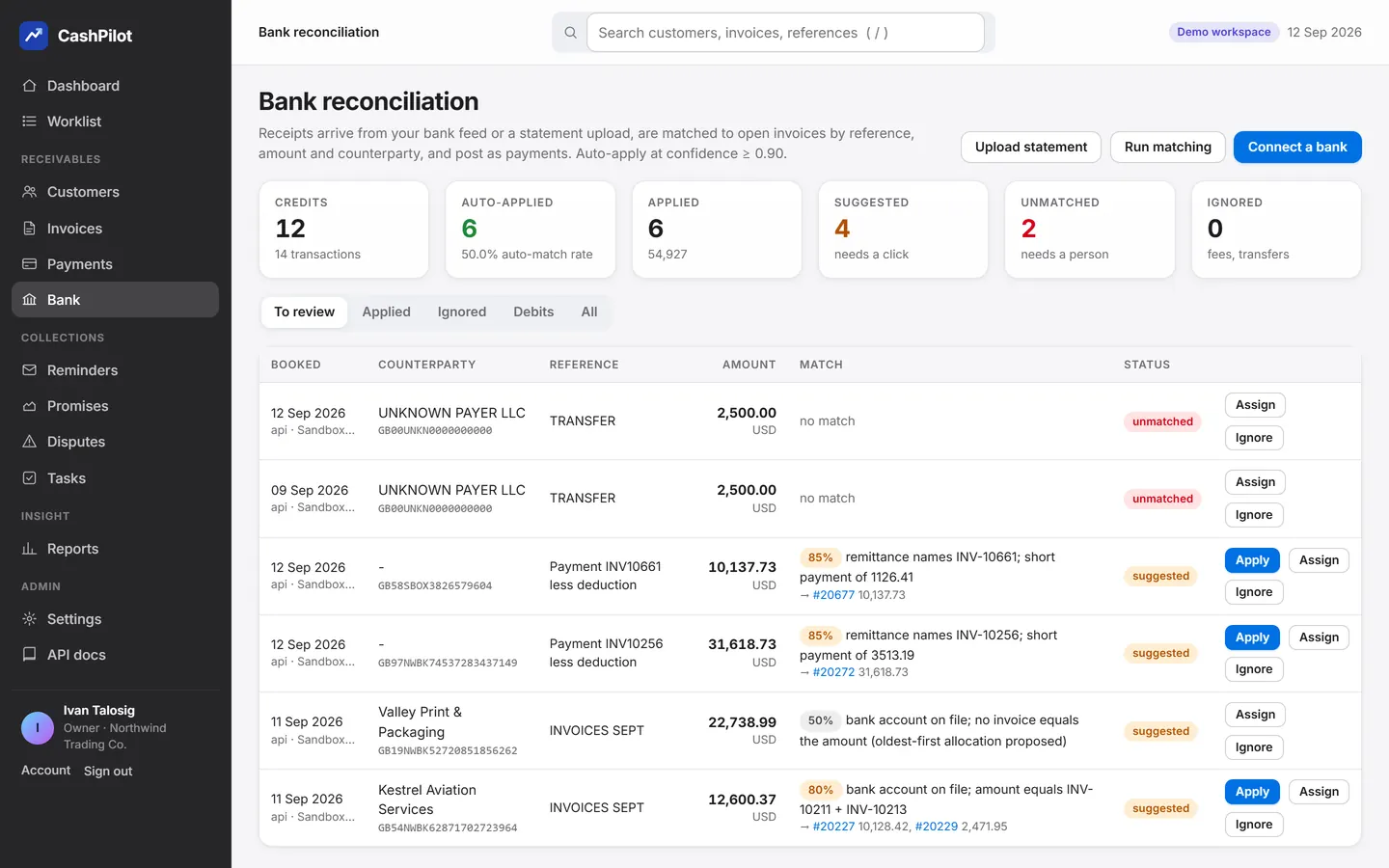
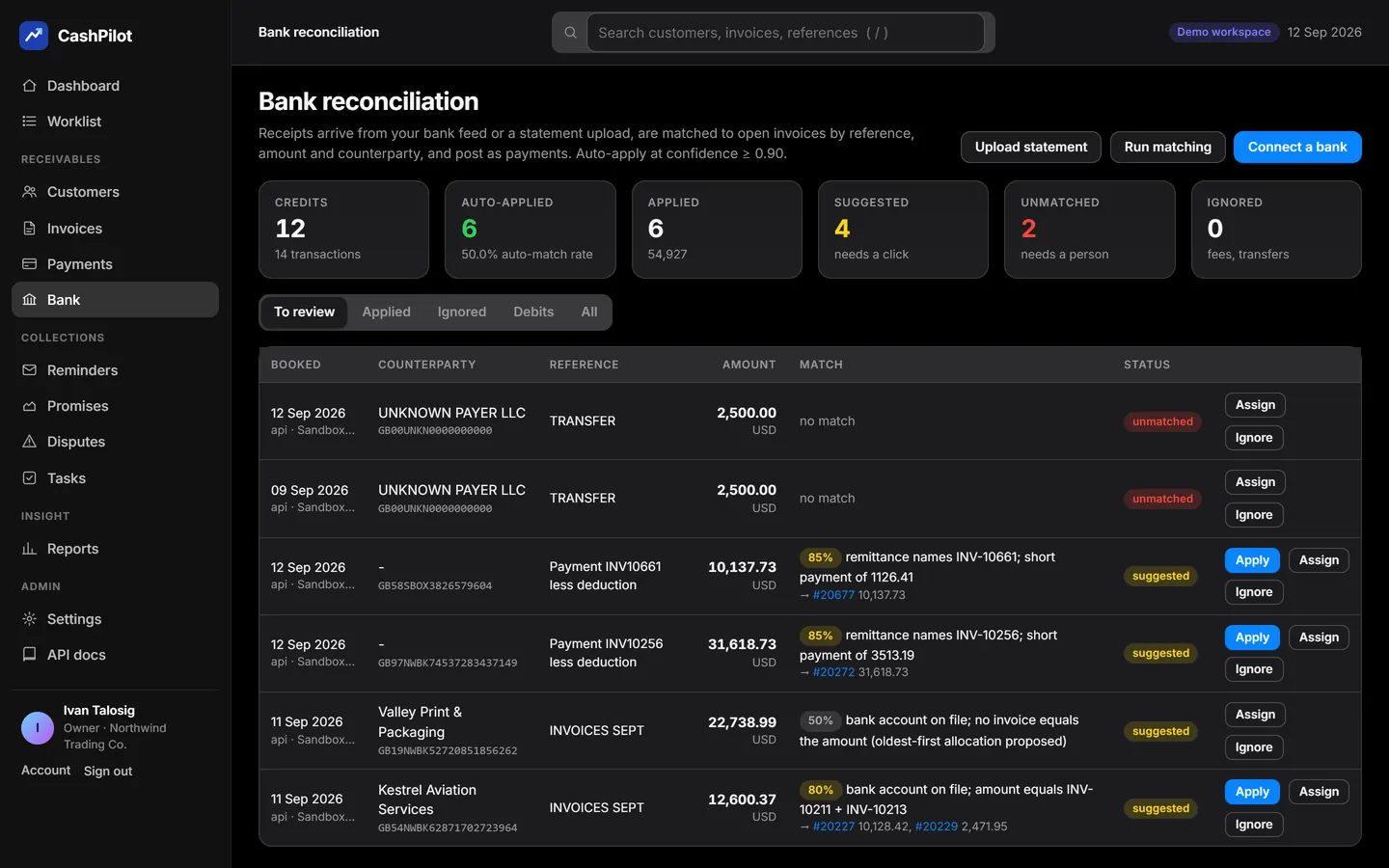
Card payments post on signed Stripe webhooks. Bank lines arrive as camt.053, MT940, OFX or CSV, or through Plaid and GoCardless, and are matched by reference, amount and payer.
- Five-rule matching hierarchy with confidence scores and an auto-apply threshold.
- Reconciliation queue: apply, assign, ignore, with full audit.
- Sample statements generated from your own data to test with.
Numbers your board already understands.
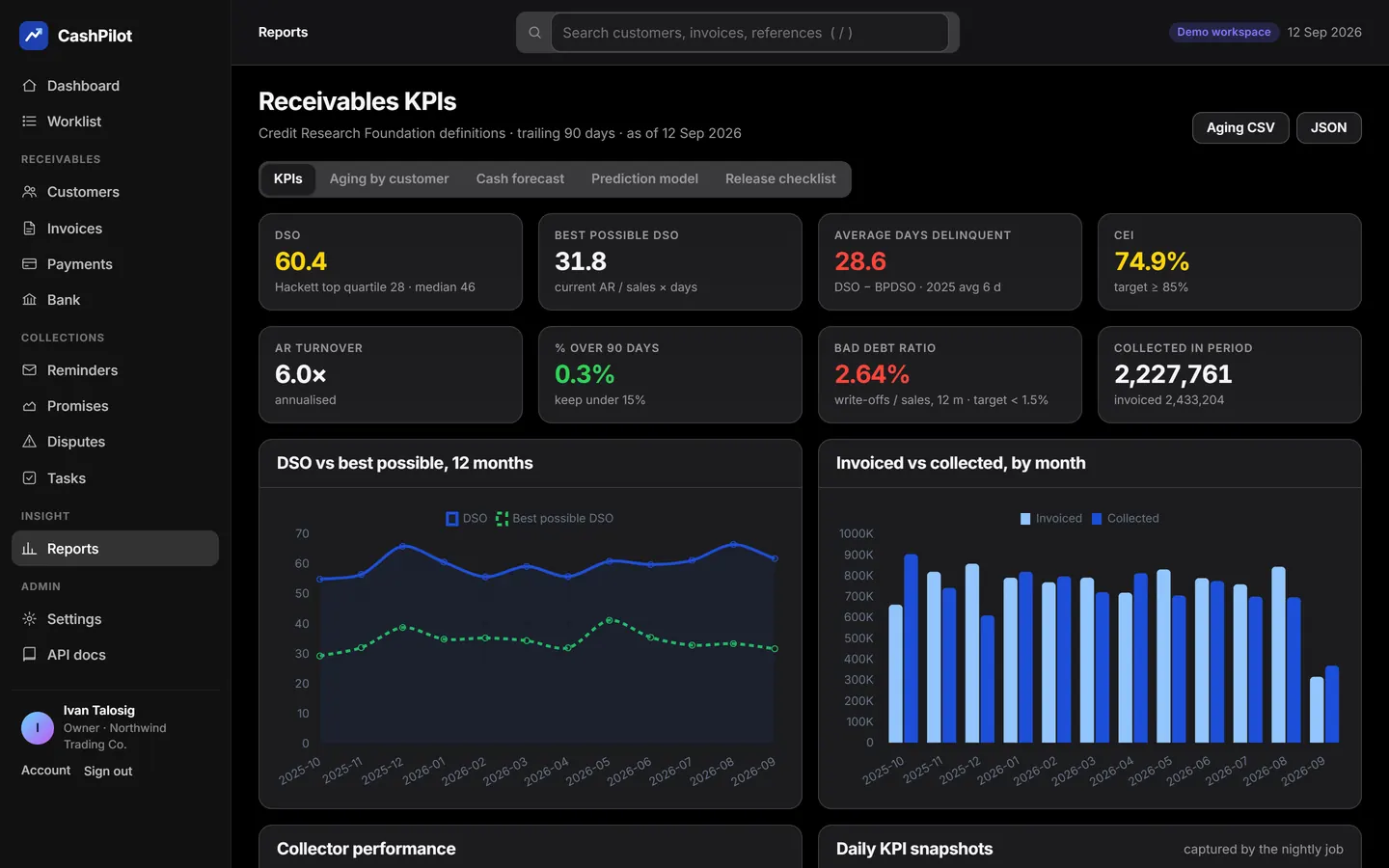
DSO trend against benchmarks, collections by month, aging by customer, collector performance and the release checklist, all exportable.
- Twelve-month DSO and collections trends.
- Aging report with CSV export.
- Collector performance: reminders, promises, cash collected.
Stop financing your customers’ cash flow.
Import a CSV and see your own ranked worklist and 13-week forecast in about ten minutes. Or click around the live demo workspace with 18 months of ledger history.